The carbon credit lifecycle
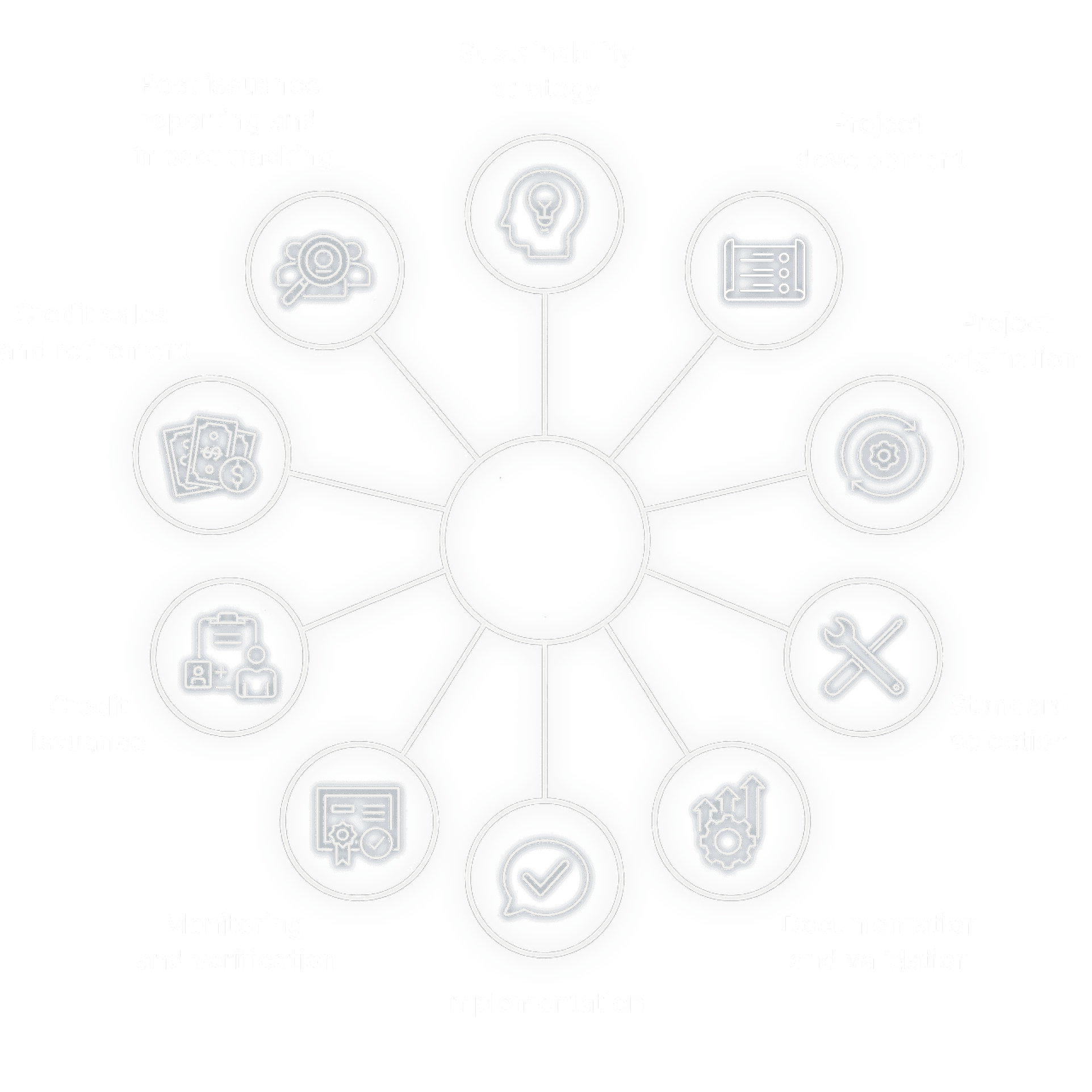
Our step-by-step certification process ensures every carbon credit is rooted in transparency, integrity, and real-world impact.
N50 guides projects through a rigorous, end-to-end certification carbon credit lifecycle process that transforms sustainability strategies into verified, high-impact carbon credits. From defining ESG goals and designing projects, to integrating socioeconomic benefits, tracking emissions reductions, and issuing credits under the SILC system—we ensure each step meets global standards for environmental integrity and community value.
Our process supports project developers and buyers alike with transparent validation, registration, and monetization—all backed by independent oversight and designed for long-term accountability.
Our process
Our process
Our process
01
Sustainability strategy
The foundation of any carbon credit initiative is a clear and actionable sustainability strategy. This step involves outlining long-term environmental, social, and governance (ESG) objectives and aligning them with both global standards and local priorities. This sets the direction for the project and guides all subsequent decisions. Key elements include defining the project type and its sustainability goals that are aligned with relevant policies; such as the Paris Agreement or national climate commitments that include equity, inclusion, and community benefit from the outset. By defining the correct strategy at the outset, project teams can ensure cohesion, accountability, and maximum impact throughout the carbon credit lifecycle. The journey from initiating a carbon reduction project to using certified offsets is a structured, multi-step process. It ensures the credibility of emissions reductions and the integrity of the credits used to offset
01
Sustainability strategy
The foundation of any carbon credit initiative is a clear and actionable sustainability strategy. This step involves outlining long-term environmental, social, and governance (ESG) objectives and aligning them with both global standards and local priorities. This sets the direction for the project and guides all subsequent decisions. Key elements include defining the project type and its sustainability goals that are aligned with relevant policies; such as the Paris Agreement or national climate commitments that include equity, inclusion, and community benefit from the outset. By defining the correct strategy at the outset, project teams can ensure cohesion, accountability, and maximum impact throughout the carbon credit lifecycle. The journey from initiating a carbon reduction project to using certified offsets is a structured, multi-step process. It ensures the credibility of emissions reductions and the integrity of the credits used to offset
01
Sustainability strategy
The foundation of any carbon credit initiative is a clear and actionable sustainability strategy. This step involves outlining long-term environmental, social, and governance (ESG) objectives and aligning them with both global standards and local priorities. This sets the direction for the project and guides all subsequent decisions. Key elements include defining the project type and its sustainability goals that are aligned with relevant policies; such as the Paris Agreement or national climate commitments that include equity, inclusion, and community benefit from the outset. By defining the correct strategy at the outset, project teams can ensure cohesion, accountability, and maximum impact throughout the carbon credit lifecycle. The journey from initiating a carbon reduction project to using certified offsets is a structured, multi-step process. It ensures the credibility of emissions reductions and the integrity of the credits used to offset
02
Project development
We begin by identifying promising emission reduction or removal opportunities across sectors such as renewable energy, forestry, regenerative agriculture, and carbon removal technologies. Our team collaborates with local communities, developers, and stakeholders to co-create project concepts that are environmentally robust and socially inclusive. Early-stage efforts include feasibility assessments, baseline scenario modeling, land tenure validation, and stakeholder engagement.
02
Project development
We begin by identifying promising emission reduction or removal opportunities across sectors such as renewable energy, forestry, regenerative agriculture, and carbon removal technologies. Our team collaborates with local communities, developers, and stakeholders to co-create project concepts that are environmentally robust and socially inclusive. Early-stage efforts include feasibility assessments, baseline scenario modeling, land tenure validation, and stakeholder engagement.
02
Project development
We begin by identifying promising emission reduction or removal opportunities across sectors such as renewable energy, forestry, regenerative agriculture, and carbon removal technologies. Our team collaborates with local communities, developers, and stakeholders to co-create project concepts that are environmentally robust and socially inclusive. Early-stage efforts include feasibility assessments, baseline scenario modeling, land tenure validation, and stakeholder engagement.
04
Standard selection
Each project is mapped to the most suitable carbon standard, whether for the voluntary market or compliance markets (e.g., CARB, EU ETS, RGGI). Selection is based on geography, credit type, project attributes, and buyer demand. SILC criteria ensure methodological integrity, legal compliance, and eligibility for tokenization or forward finance instruments like Carbon Funding Commitments (CFCs).
04
Standard selection
Each project is mapped to the most suitable carbon standard, whether for the voluntary market or compliance markets (e.g., CARB, EU ETS, RGGI). Selection is based on geography, credit type, project attributes, and buyer demand. SILC criteria ensure methodological integrity, legal compliance, and eligibility for tokenization or forward finance instruments like Carbon Funding Commitments (CFCs).
04
Standard selection
Each project is mapped to the most suitable carbon standard, whether for the voluntary market or compliance markets (e.g., CARB, EU ETS, RGGI). Selection is based on geography, credit type, project attributes, and buyer demand. SILC criteria ensure methodological integrity, legal compliance, and eligibility for tokenization or forward finance instruments like Carbon Funding Commitments (CFCs).
03
Project origination
Once development parameters are defined, we conduct detailed due diligence using remote sensing data, field surveys, and risk analysis to validate project viability. Projects are matched to appropriate methodologies and implementation partners. During this phase, preliminary Monitoring, Reporting, and Verification (MRV) protocols are also drafted in alignment with the SILC Certification framework.
03
Project origination
Once development parameters are defined, we conduct detailed due diligence using remote sensing data, field surveys, and risk analysis to validate project viability. Projects are matched to appropriate methodologies and implementation partners. During this phase, preliminary Monitoring, Reporting, and Verification (MRV) protocols are also drafted in alignment with the SILC Certification framework.
03
Project origination
Once development parameters are defined, we conduct detailed due diligence using remote sensing data, field surveys, and risk analysis to validate project viability. Projects are matched to appropriate methodologies and implementation partners. During this phase, preliminary Monitoring, Reporting, and Verification (MRV) protocols are also drafted in alignment with the FLFCO Certification framework.
05
Documentation & validation
The project team prepares a comprehensive Project Design Document (PDD) outlining the methodology, baseline emissions, monitoring plan, and expected impact. Independent third-party validators then review the PDD for technical soundness and alignment with the selected standard. This phase also includes socioeconomic baseline assessments to integrate SEI metrics early in the process.
05
Documentation & validation
The project team prepares a comprehensive Project Design Document (PDD) outlining the methodology, baseline emissions, monitoring plan, and expected impact. Independent third-party validators then review the PDD for technical soundness and alignment with the selected standard. This phase also includes socioeconomic baseline assessments to integrate SEI metrics early in the process.
05
Documentation & validation
The project team prepares a comprehensive Project Design Document (PDD) outlining the methodology, baseline emissions, monitoring plan, and expected impact. Independent third-party validators then review the PDD for technical soundness and alignment with the selected standard. This phase also includes socioeconomic baseline assessments to integrate SEI metrics early in the process.
06
Implementation
Upon validation, the project proceeds to implementation—whether planting trees, capturing methane, or deploying renewable infrastructure. We oversee deployment logistics, community onboarding, and field calibration. Our implementation includes training for local personnel, equitable labor models, and traceable procurement in line with social equity commitments.
06
Implementation
Upon validation, the project proceeds to implementation—whether planting trees, capturing methane, or deploying renewable infrastructure. We oversee deployment logistics, community onboarding, and field calibration. Our implementation includes training for local personnel, equitable labor models, and traceable procurement in line with social equity commitments.
06
Implementation
Upon validation, the project proceeds to implementation—whether planting trees, capturing methane, or deploying renewable infrastructure. We oversee deployment logistics, community onboarding, and field calibration. Our implementation includes training for local personnel, equitable labor models, and traceable procurement in line with social equity commitments.
07
Monitoring & verification
We initiate continuous monitoring using ground data, drones, satellites, and IoT sensors. This ensures real-time data is available for subsequent verification and reporting. After a defined operational period, the project undergoes third-party verification to quantify actual emissions reductions or removals achieved.
07
Monitoring & verification
We initiate continuous monitoring using ground data, drones, satellites, and IoT sensors. This ensures real-time data is available for subsequent verification and reporting. After a defined operational period, the project undergoes third-party verification to quantify actual emissions reductions or removals achieved.
07
Monitoring & verification
We initiate continuous monitoring using ground data, drones, satellites, and IoT sensors. This ensures real-time data is available for subsequent verification and reporting. After a defined operational period, the project undergoes third-party verification to quantify actual emissions reductions or removals achieved.
08
Credit issuance
Following successful verification, credits are issued under the chosen registry, each assigned a serialized, tamper-proof ID. For projects under SILC, Carbon Funding Commitments are matched with actual carbon output, and digital twins of each credit are optionally tokenized to enable trade in digital marketplaces.
08
Credit issuance
Following successful verification, credits are issued under the chosen registry, each assigned a serialized, tamper-proof ID. For projects under SILC, Carbon Funding Commitments are matched with actual carbon output, and digital twins of each credit are optionally tokenized to enable trade in digital marketplaces.
08
Credit issuance
Following successful verification, credits are issued under the chosen registry, each assigned a serialized, tamper-proof ID. For projects under SILC, Carbon Funding Commitments are matched with actual carbon output, and digital twins of each credit are optionally tokenized to enable trade in digital marketplaces.
09
Credit sale & retirement
Verified credits are offered to buyers via direct institutional partnerships. After purchase, credits are retired in public registries to prevent double-counting. All transactions are traceable through our SILC dashboard and can be aligned with Scope 1, 2, or 3 climate disclosures.
09
Credit sale & retirement
Verified credits are offered to buyers via direct institutional partnerships. After purchase, credits are retired in public registries to prevent double-counting. All transactions are traceable through our SILC dashboard and can be aligned with Scope 1, 2, or 3 climate disclosures.
09
Credit sale & retirement
Verified credits are offered to buyers via direct institutional partnerships. After purchase, credits are retired in public registries to prevent double-counting. All transactions are traceable through our SILC dashboard and can be aligned with Scope 1, 2, or 3 climate disclosures.
10
Post-issuance reporting & impact tracking
We support our partners with dynamic reporting tools that visualize climate and SEI outcomes, allowing buyers to communicate impact and align credits with ESG goals. Ongoing reporting includes lifecycle assessments, SROI, SEI metrics, and compliance-grade disclosures.
10
Post-issuance reporting & impact tracking
We support our partners with dynamic reporting tools that visualize climate and SEI outcomes, allowing buyers to communicate impact and align credits with ESG goals. Ongoing reporting includes lifecycle assessments, SROI, SEI metrics, and compliance-grade disclosures.
10
Post-issuance reporting & impact tracking
We support our partners with dynamic reporting tools that visualize climate and SEI outcomes, allowing buyers to communicate impact and align credits with ESG goals. Ongoing reporting includes lifecycle assessments, SROI, SEI metrics, and compliance-grade disclosures.
Get in touch
Whether you're a organization, project developer, investor, or sustainability officer, there are many ways to collaborate with N50. Fill in the form and we'll contact you as soon as possible.
By completing this form, you agree to us using your details to contact you about your enquiry and for ongoing marketing purposes. For information about how we use your personal information, please refer to our privacy policy

Contact details
Get in touch
Whether you're a organization, project developer, investor, or sustainability officer, there are many ways to collaborate with N50. Fill in the form and we'll contact you as soon as possible.
By completing this form, you agree to us using your details to contact you about your enquiry and for ongoing marketing purposes. For information about how we use your personal information, please refer to our privacy policy
Contact details
Get in touch
Whether you're a organization, project developer, investor, or sustainability officer, there are many ways to collaborate with N50. Fill in the form and we'll contact you as soon as possible.
By completing this form, you agree to us using your details to contact you about your enquiry and for ongoing marketing purposes. For information about how we use your personal information, please refer to our privacy policy